Award-winning project
Etecnic Plus: AI for electric mobility maintenance
Over two hackathon days, my team and I worked on Etecnic Plus. The project won the technological innovation first prize at Universitat Rovira i Virgili's SmAIrt Mobility Hackathon in Tarragona.
We started with a problem that is easy to explain and difficult to organize: which incident comes first, who should handle it and which route still makes sense when the plan changes in real time.
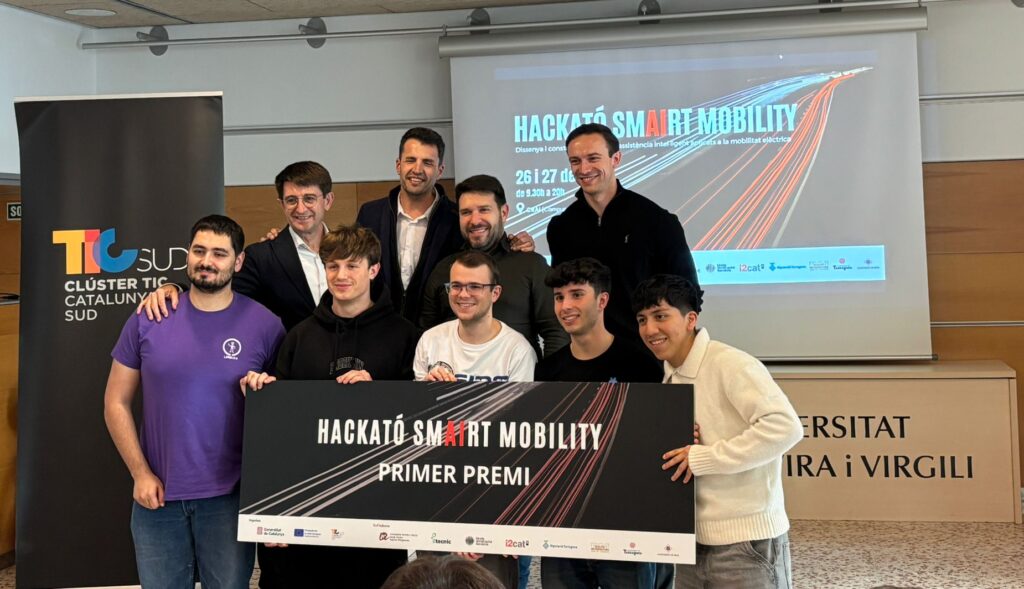
- Recognition
- Technological innovation first prize
- Date
- March 27, 2026
- Challenge
- Charging-point maintenance
The challenge
Charging infrastructure maintenance combines incidents with different urgency, technicians with different availability and skills, distances, routes and unexpected changes. Solving each variable separately does not guarantee an efficient overall plan.
The hackathon asked teams to design an intelligent assistance system for better maintenance planning and execution. Around forty URV engineering students took part in two days of design and prototyping.
What we built
Etecnic Plus brought together incidents, staff availability and planning. From that information, it ordered priorities, assigned technicians and proposed routes to reduce response times.
The hard part was not attaching an AI label to the project, but representing the problem well: which intervention was urgent, who could handle it, where they were and how each assignment affected the rest of the plan.
- Incident and maintenance-task prioritization.
- Technician assignment based on availability and context.
- Travel and route planning.
- Replanning after operational changes and unexpected events.
The result
URV's Digital Newspaper reported on March 27, 2026 that Etecnic Plus received the technological innovation first prize. Its account highlighted the real-time assignment of technicians, routes and priorities, as well as the integration of incidents with staff availability.
The same source places the project within a challenge promoted by the Southern Catalonia ICT Cluster and the Government of Catalonia, with collaboration from URV's School of Engineering, Etecnic, Mobile World Capital, i2CAT and regional institutions.
What I took from those two days
With so little time, we had to decide early what was essential and what could wait. We agreed on variables, constraints and a measure of success before moving into the interface and prototype logic.
It also confirmed something I now carry into other projects: a tool can order priorities and help a team react, but it should keep its reasoning visible and preserve the team's judgment.
Sources and verification
Public references used to support the factual claims on this page.