URV-T-Systems AI Hackathon
GLOBAL: tracing a housing law through to the market
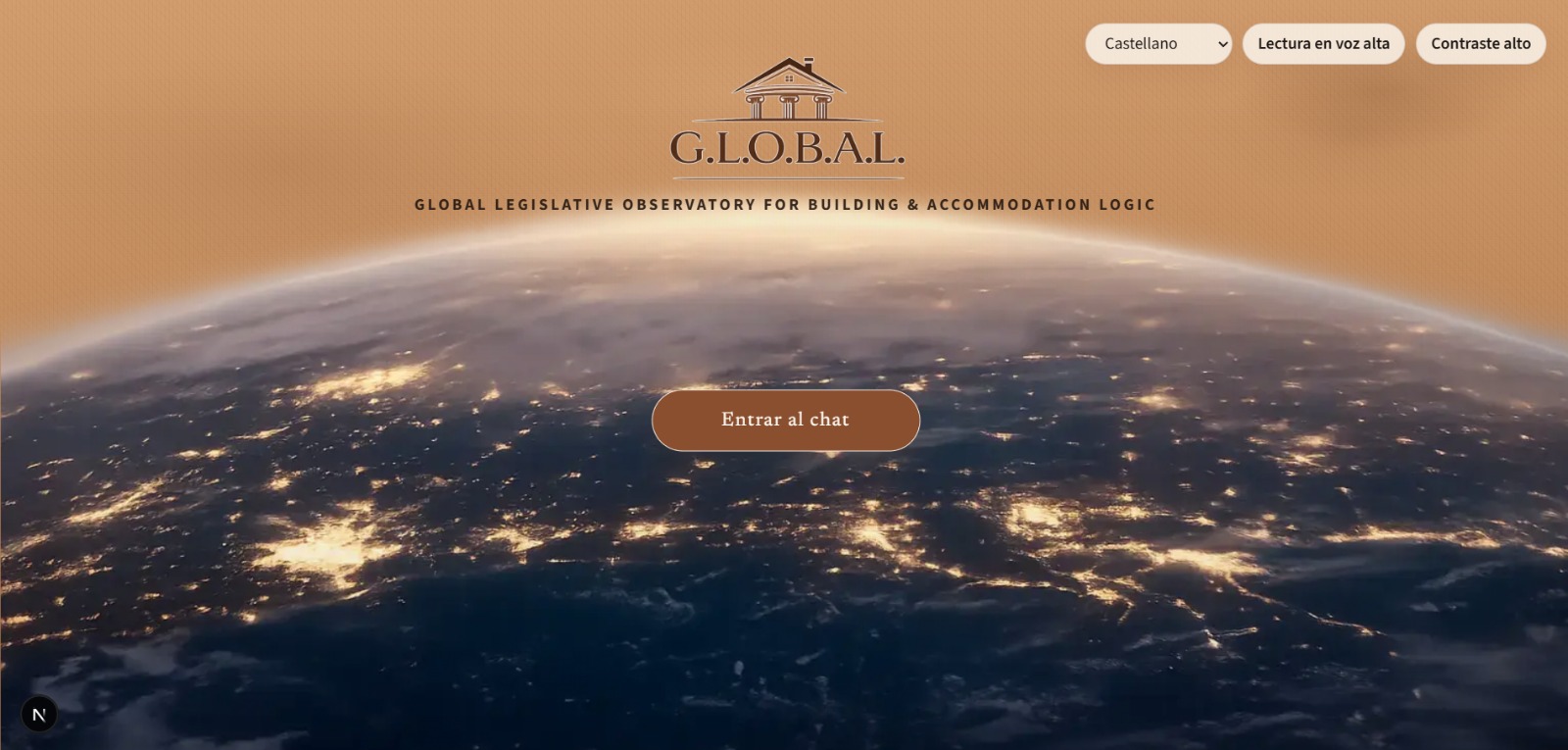
At the 2026 URV-T-Systems AI Hackathon, we built GLOBAL, a platform that connects housing legislation, market data and documentary evidence without making users read every source separately.
The challenge was to turn complex policy questions into explainable comparisons and scenarios: what changed, which evidence supports a conclusion and how far that conclusion can be trusted.
- Challenge
- Public housing policy
- Setting
- URV-T-Systems AI Hackathon 2026
- Stack
- Next.js · FastAPI · RAG · DuckDB
A question that does not fit in one chart
Housing laws operate alongside interest rates, supply, wages and the decisions of owners, tenants and investors. Comparing one indicator before and after a reform is rarely enough to explain what happened.
GLOBAL was designed as an observatory that connects rules, datasets and documents to study change across countries and periods. Its interface adjusts the depth of each answer so it remains useful without legal or economic training.
What we built
The product combines a conversational experience with maps, comparisons and inspectable sources. A user can ask a question, review the retrieved evidence and explore how different decisions might affect prices, supply or access to housing.
The prototype separates document retrieval, data analysis and explanation generation. That structure makes it possible to show where a claim comes from and avoids presenting a scenario as established fact.
- Accessible, multilingual frontend with Next.js, React and TypeScript.
- Analysis API with FastAPI and retrieval-augmented generation workflows.
- Structured data in DuckDB and SQLite; semantic search with Chroma.
- Multiple models used to generate answers grounded in sources.
My contribution and what I learned
I worked with the team on building the product and turning a broad corpus of laws, reports and indicators into a flow we could demonstrate during the hackathon.
The project reinforced an idea I also apply in healthtech: when a decision depends on mixed evidence, the interface should expose sources, separate facts from inferences and make the system's limits clear.
A verifiable, open project
The T-Systems X URV Chair published the official project profile on March 24, 2026. It identifies Idriss El Ouazzani as a member of Group 5, describes the UNESCO Housing Chair challenge and links to the prototype repository.
The public repository preserves the frontend, backend and data materials used by the team, so the architecture and scope can be inspected beyond this page.
Sources and verification
Public references used to support the factual claims on this page.